A Kelly-kritérium és a rulett
A Kelly-kritérium megmondja annak, akinek előnye van, mekkora tétet tegyen. A rulettre egyértelmű választ ad: semekkorát.

Kelly-tét = előny / kifizetési arány. Negatív előnynél a képlet negatív hányadot ad, ami azt jelenti: ne tégy. A kritérium attól még hasznos annak megértéséhez, miért méretezték úgy a tétjeiket a torzításra játszók, ahogy tették, és miért kell mindenki másnak a keret szerint méreteznie.
A kritérium
John Kelly (1956) asked how a gambler with a known edge should size bets to maximize long-run growth of the bankrollpénzBankrollA játékra félretett teljes összeg. A bankrollkezelés annak eldöntése, mennyit kockáztatsz belőle tétenként és játékmenetenként.Teljes cikk →. The answer, for a bet paying b to 1 with win probabilitymatematikaValószínűségEgy kimenetel esélye, 0-tól 1-ig vagy 0%-tól 100%-ig. Egy szám: 1/37 = 2,70%.Teljes cikk → p and loss probability q = 1 − p, is to stake the fraction f* = (bp − q) / b of the bankroll. Positive f* means bet that fraction; zero or negative means do not bet. Kelly worked at Bell Labs, and his paper, “A new interpretation of information rate”, set the problem in Claude Shannon’s theory of information: a gambler who gets tips over a noisy line, at fair odds, can grow the bankroll at best at the rate the line carries information. This is a growth objective under a probability model, not a promise to finish ahead after a particular number of bets. A spending limit, finite deadline or payoutpénzKifizetésAmit a nyertes tét visszaad, „X az 1-hez” formában megadva, a visszajáró téten felül.Teljes cikk → cap changes the decision problem.
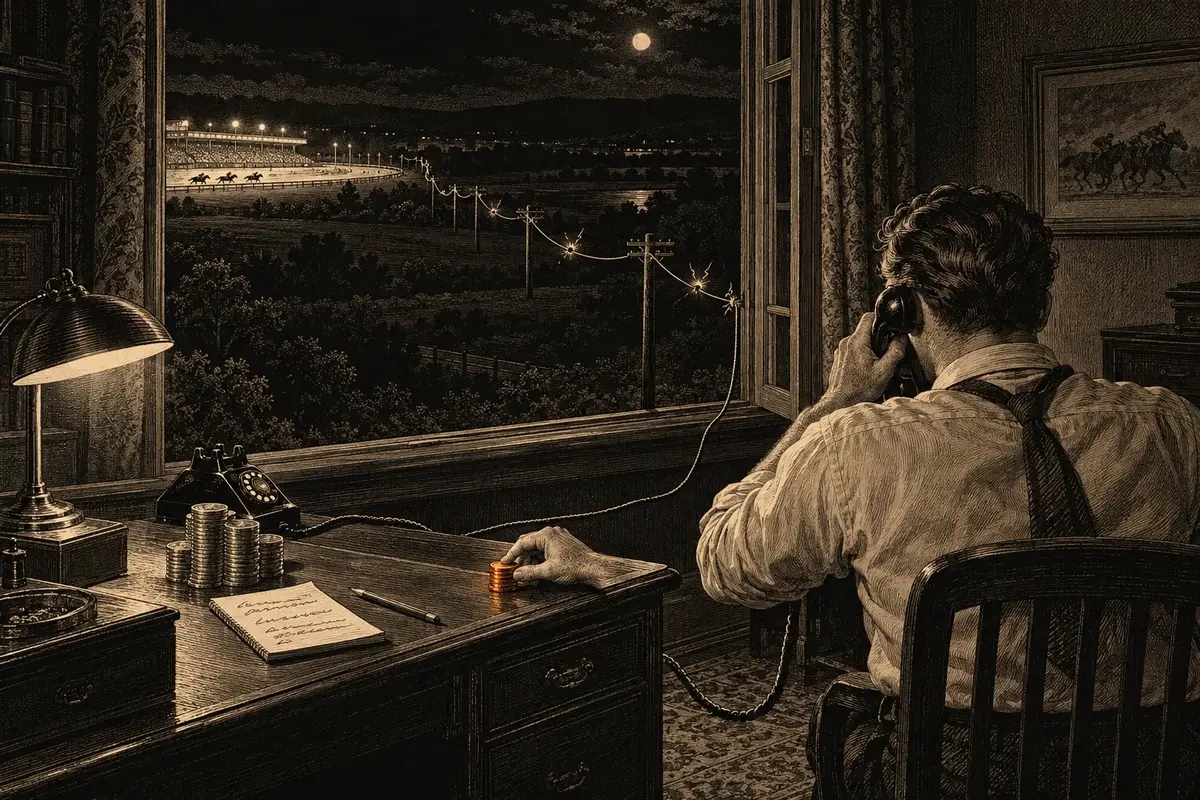
Kelly-tétezés a rulettben
For redtétPirosEgyszerű esély a 18 piros számra. Franciául: rouge.Teljes cikk →: b = 1, p = 18/37, q = 19/37; f* = (18/37 − 19/37)/1 = −1/37. For a straight uptétTeljes számEgyetlen szám, 35:1 arányban fizet.Teljes cikk →: b = 35, p = 1/37, q = 36/37; f* = (35/37 − 36/37)/35 = −1/1295. Every standard bet gives a negative Kelly fraction, because every bet has a negative edge, and the growth-optimal stake is zero. Kelly betting on roulette is a formal way of saying what the house-edge page says: no positive stake maximizes expected logarithmic growth when the bet has negative expectation. A particular session can still end in profit. La partageszabályLa partageFrancia szabály: ha zéró jön ki, az egyszerű esélyre tett tét fele visszajár. Ezeken a téteken 1,35%-ra felezi a házelőnyt.Teljes cikk → needs a separate three-outcome calculation: a win, a full loss or a half-loss on zerokerékZéróAz egyetlen zöld rekesz, amelyet sem egyszerű esély, sem tucat, sem oszlop nem fed le; a házelőny forrása. Más néven: egyetlen zéró, 0.Teljes cikk →. Its expected log growth also falls as the stake increases from zero.
Ahol a Kelly-kritérium tényleg számított
Suppose a pocketfelszerelésRekeszA rotor 37 számozott rekeszének egyike. Angolul még: slot, cup.Teljes cikk → really has a stable, known probability of 1 in 30 and pays 35 to 1. The Kelly fraction is 0.57%: about $57 from a $10,000 bankroll. Under independent spinsmatematikaFüggetlen pörgetésekMinden pörgetésnek ugyanazok a valószínűségei, az előzményektől függetlenül. Az oldal minden számításának ez az alapja.Teljes cikk → and exact fractional staking, the geometric growth factor over 1,000 spins is about 1.7. Expected bankroll grows faster because rare large wins pull up the average. These are model calculations, not evidence that any named historical player used Kelly or achieved this result.
Jellemző és átlagos
The gap between the typical bankroll and the average one is wide. Take a pocket that hits 1 time in 25, a hypothetical edge of 44% per unitpénzEgységAz alaptét, amelyben egy rendszer vagy egy játékos számol. A progressziókat egységekben írják le, hogy bármelyik asztalon alkalmazhatók legyenek.Teljes cikk → staked. Kelly stakes 1.26% of the bankroll on it. After 1,000 spins the typical bankroll has grown about 11.5 times, while the average, pulled up by a few very lucky runs, has grown about 249 times. Betting more than Kelly raises the average and lowers the typical result: at twice the Kelly stake the typical bankroll only doubles, and by two and a half times the Kelly stake it shrinks, although every bet still carries a 44% edge. In this example, half-Kelly retains about 78% of the expected log growth. This fraction depends on the probabilities and payout.
Amikor az előny csak becslés
Kelly uses the true probabilities, but a player usually has only estimates. Selecting the busiest pocket from a past record creates a selection problem: even a fair wheel has a busiest pocket. Its observed rate can overstate its future probability. Choosing the stake from that same record compounds the error. An independent follow-up sample helps test a proposed bias (see How to Detect Roulette Wheel Bias). Reducing the calculated fraction reduces exposure, but cannot turn a false edge into a real one.
Emberek előnnyel
Haghani and Dewey (2016) studied 61 participants given $25 and 30 minutes to bet on a simulated coin with a disclosed 60% chance of heads. The payout cap was $250; its value was revealed when a proposed winning bet would reach it. Their reported 21% success category included balances of at least $200, while the 28% “bust” category meant less than $2, not necessarily zero. Eighteen participants bet their entire balance on one flip. The uncapped Kelly fraction is 20%, but the cap and deadline change the optimization problem. The experiment illustrates how stake choices matter even with a known advantage; it does not establish one best strategy for every objective.
Mit használj helyette
Előny nélkül a tétméretezés költségvetési kérdés, nem növekedési: tét = amennyit pörgetésenként hajlandó vagy elkölteni, az óránkénti keretből és az asztal tempójából levezetve (lásd a bankrollkezelésről szóló oldalt). A Kelly-kritérium hozzájárulása az átlagos játékos számára a válasza egyértelműsége: nulla. Minden, amit nulla fölött felteszel, a játék ára, amelyet te választasz, és nem valamilyen képlet optimalizál.
Megjegyzés a tört Kelly-tétről és a „pénzkezelésről”
Betting a fixed percentage of the current bankroll is proportional staking: the stake rises after wins and falls after losses. Flat bettingstratégiaAzonos tétes játékMinden pörgetésnél ugyanakkora tét. Ez az alapeset, amelyhez minden progressziót hasonlítanak.Teljes cikk → instead keeps the cash stake fixed. Neither creates an edge on ordinary roulette. With infinitely divisible stakes and a fraction below 100%, proportional staking never reaches exactly zero in finitely many losses, but the balance can become arbitrarily small. Real table minimums can prevent further play much sooner. The growth-optimal fraction remains zero.
Képlet
Kérdések
Only when the actual probabilities, payouts and conditions give a credible positive advantage. Standard bets on an unbiased wheel have no such advantage.
Using half the calculated fraction reduces exposure to errors in the estimated edge. The familiar three-quarters-growth rule is an approximation for small advantages, not a universal identity. It does not protect against an edge that does not exist.
Nem. A Kelly-kritérium adott előny mellett optimalizálja a növekedést. A bankrollkezelés előny nélkül tartja kordában a költést.
Játékos matek
Előbb próbáld meg magad. Minden megoldás össze van csukva; nyisd ki, ha készen állsz.
Suppose a hypothetical bet on one number has a known 44% edge under standard payoutspénzKifizetésAmit a nyertes tét visszaad, „X az 1-hez” formában megadva, a visszajáró téten felül.Teljes cikk → and independent spinsmatematikaFüggetlen pörgetésekMinden pörgetésnek ugyanazok a valószínűségei, az előzményektől függetlenül. Az oldal minden számításának ez az alapja.Teljes cikk →. Kelly gives a 1.26% bankrollpénzBankrollA játékra félretett teljes összeg. A bankrollkezelés annak eldöntése, mennyit kockáztatsz belőle tétenként és játékmenetenként.Teljes cikk → fraction. What if the same 44% edge came on one bet spread over five neighboring numbers?
A megoldás megjelenítése
Válasz Akkor a Kelly-kritérium a bankroll 7,1%-át javasolja, és a bankroll majdnem hatszor olyan gyorsan nő: 1000 tét alatt körülbelül 1,25 milliószorosára, szemben a körülbelül 11,5-szeresével.
A straight uptétTeljes számEgyetlen szám, 35:1 arányban fizet.Teljes cikk → with a 44% edge wins with chance 0.04, since 36 × 0.04 = 1.44. Kelly’s stake is the edge divided by the odds: 0.44/35 = 1.26%. The typical growth per bet is 0.04 × ln(1 + 35 × 0.0126) + 0.96 × ln(1 − 0.0126) ≈ 0.00244, so 1,000 bets multiply the bankroll by about e^2.44 ≈ 11.5.
Spread one stake over five numbers and the bet wins with chance 0.20 and pays 36/5 for 1, that is 6.2 to 1: still a 44% edge, since 0.2 × 7.2 = 1.44. Kelly’s stake becomes 0.44/6.2 = 7.10%, and the growth per bet 0.01404, about 5.75 times as much. Over 1,000 bets that is e^14.04, about 1.25 million.
The edge is the same; the swings are smaller. A bet that wins one time in five has a larger growth-optimal fraction in this model, although losses can still reduce the bankroll severely. This comparison assumes the same known edge for both bets; actual predictions need independent evidence.
Assume two numbers are adjacent on the betting layoutfelszerelésTablóAz asztalra nyomtatott tétrács. Más néven: asztal, filc, posztó.Teljes cikk → and each has a stable, known probabilitymatematikaValószínűségEgy kimenetel esélye, 0-tól 1-ig vagy 0%-tól 100%-ig. Egy szám: 1/37 = 2,70%.Teljes cikk → of 1 in 25 on independent spins. Compare a splittétOsztott tétKét szomszédos szám, 17:1 arányban fizet.Teljes cikk → between them at 17 to 1 with equal straight-up stakes on the two numbers. How much does Kelly say, and how fast does the bankroll grow compared with one such pocketfelszerelésRekeszA rotor 37 számozott rekeszének egyike. Angolul még: slot, cup.Teljes cikk →?
A megoldás megjelenítése
Válasz Nincs különbség: a bankroll 2,59%-a az osztott téten, vagy 1,29%-a mindkét számon. A tipikus bankroll 1000 pörgetés alatt körülbelül 155-szörösére nő, szemben az egy rekesszel elérhető 11,5-szeressel.
The split wins with probability 2/25 = 0.08 and pays 17 to 1, so it returns 18 × 0.08 = 1.44 per unitpénzEgységAz alaptét, amelyben egy rendszer vagy egy játékos számol. A progressziókat egységekben írják le, hogy bármelyik asztalon alkalmazhatók legyenek.Teljes cikk → staked: an edge of 44%, the same as one biased pocket. Kelly’s stake is the edge divided by the odds: 0.44/17 = 2.59%.
Two straight-up bets of 1.29% each give exactly the same results. When either number comes up, one chippénzZsetonRögzített összeget képviselő korong, amelyet a tablóra helyezve teszel tétet. Más néven: cheque.Teljes cikk → wins 35 to 1 and the other is lost, a net of 34 × 1.29% = 44% of the bankroll, as the split pays; when neither does, both are lost.
The growth per spin is 0.00505, against 0.00244 for one pocket, so over 1,000 spins the typical bankroll grows e^5.046 ≈ 155 times rather than e^2.44 ≈ 11.5 times. The geometric growth factor is larger because the combined bet wins more often at the same 44% edge. It is a model result, not a guaranteed bankroll.
Egy kis humor
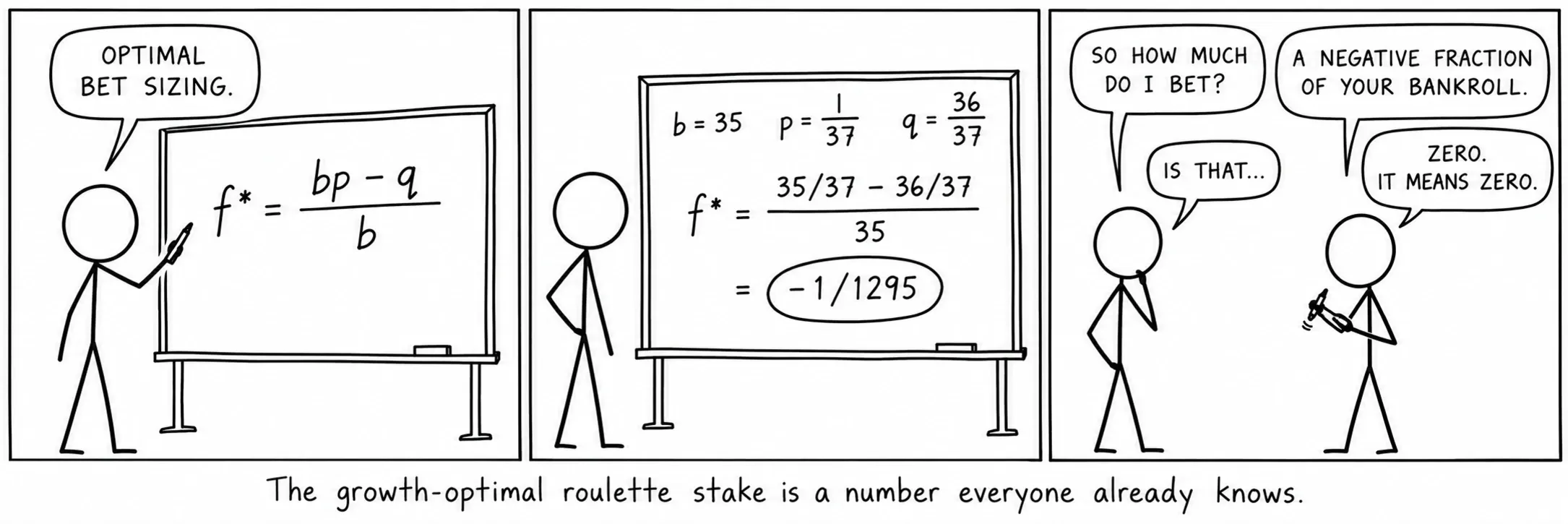
A növekedést maximalizáló rulettét egy szám, amelyet már mindenki ismer.
Források
- Kelly, J. L. “A new interpretation of information rate.”
- Breiman, L. “Optimal gambling systems for favorable games.”
- Thorp, E. O. “Optimal gambling systems for favorable games.”
- Thorp, E. O. The Mathematics of Gambling.
- Epstein, R. A. The Theory of Gambling and Statistical Logic, 2nd ed.
- Taylor, D. G. Games, Gambling, and Probability: An Introduction to Mathematics, 2nd ed.
- Ethier, S. N. The Doctrine of Chances: Probabilistic Aspects of Gambling.
- Haghani, V. & Dewey, R. “Rational decision-making under uncertainty: observed betting patterns on a biased coin.”